Rebranding the Athlete
The transition from a professional race car driver to a para-athlete wasn’t just a change in equipment; it was a total psychological overhaul. In racing, you rely on a team, an engine, and sponsors. In handcycling, it was just him, the road, and the absolute limit of his own endurance.
He didn’t want to be a sideshow. He didn’t want to be the “inspiring story” that people watched out of sympathy. He wanted to be a competitor. He treated every training session with the same obsessive precision he once applied to tuning a Formula One car.
“People look at me and see what I lost,” he once told a reporter, adjusting his grip on the handcycle handles.
“I look at myself and see what I can still do.”
He started entering local races, then national ones. The competitive fire, dormant since 2001, roared back to life. He wasn’t just moving forward; he was picking up speed. The transition from the cockpit to the handcycle was seamless because the underlying drive—the pursuit of excellence—remained untouched.

The Paralympic Peak
The path led eventually to the Paralympic Games, the ultimate stage for the unconquerable. When he arrived in London for the 2012 Games, he wasn’t there to participate; he was there to dominate.
The tension at the start line was different from the tracks he used to frequent, but the feeling was hauntingly familiar. The nerves, the focus, the absolute tunnel vision—it was all there. 🏅
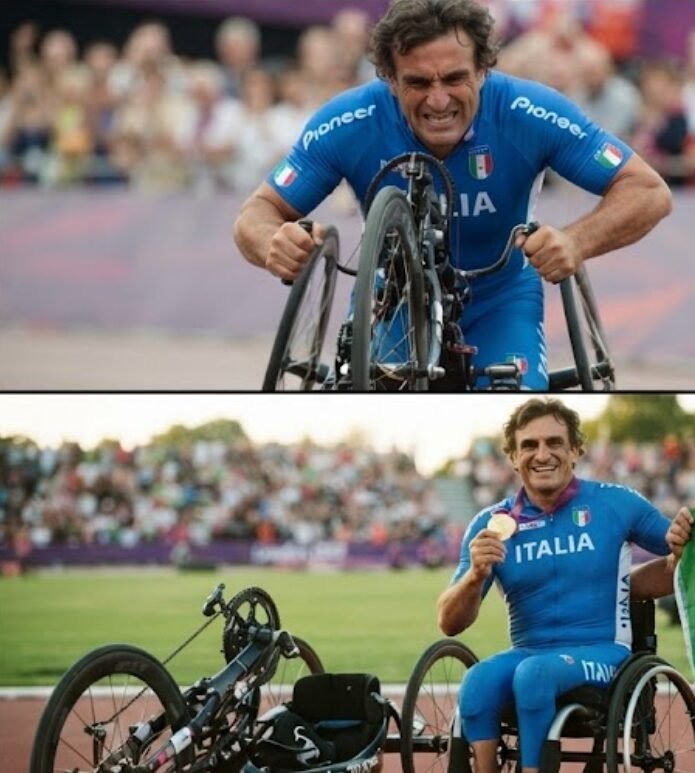
He powered through the course, his arms burning with lactic acid, his heart hammering against his chest. As he crossed the finish line to take gold, it wasn’t just a victory for Italy; it was a victory over the limitations society had imposed on him.
He raised his handcycle high above his head—a powerful, iconic image that told the world everything it needed to know. He was no longer a man who had lost his legs in 2001; he was a champion who had found a new, higher gear.
Sustaining the Drive
Achieving success is a fleeting moment, but maintaining it is a lifestyle. Alex continued to compete, testing his limits in Ironmans and various endurance challenges. He proved that the human spirit isn’t defined by the physical boundaries of the body, but by the relentless pursuit of one’s own potential.
His story serves as a masterclass in resilience. It teaches us that tragedy isn’t necessarily an end point. Often, it is merely a forced detour—a brutal, painful, and messy redirection that can lead to destinations we never thought possible.
Today, when people look at his career, they don’t see a tragedy followed by a recovery. They see a singular, incredible journey of a man who refused to let his story end in the smoke of a crash. He redefined what it means to be a professional, turning his darkest day into the foundation for his greatest triumphs.
Whether on four wheels or three, the velocity remains the same. The track has changed, the scenery is different, but the man behind the machine is still, and always will be, a racer. 🇮🇹