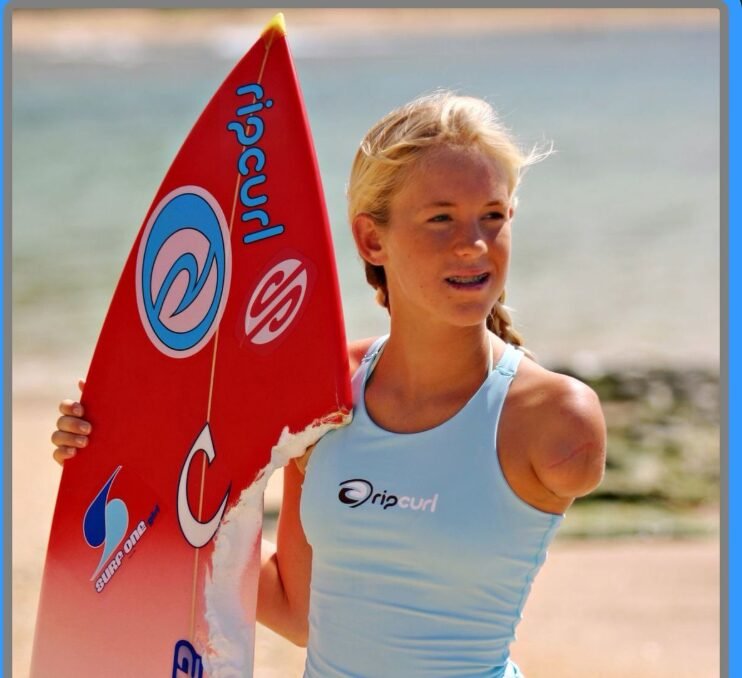
Returning to the Saltwater
The doctors and the press were already writing my obituary as an athlete. They saw a tragedy; I saw a puzzle.
“I’m going back,” I told my coach one afternoon, just a few weeks after the incident.
He looked at me, not with pity, but with the professional assessment of someone who knew the sea’s unforgiving nature.
“It’s going to be different, Bethany. The way you paddle, the way you balance, the way you pop up—you have to reinvent your entire relationship with the water.”
“I don’t care,” I said. “I just need to feel the board beneath me again.”
The first time I paddled out, the board felt alien. Without the second arm, my balance was off, and every stroke required twice the effort, forcing my core to work in ways it never had before. 🌊

I wiped out. Again. And again. The ocean, usually my sanctuary, felt like it was rejecting me.
“Don’t fight the wave,” I reminded myself, tasting the salt on my lips. “Flow with it.”
When I finally caught that first wave, it wasn’t a perfect, professional performance. It was clumsy, shaky, and terrifying. But when I stood up—really stood up—and felt the rush of speed under my feet, the fear evaporated. I hadn’t just survived; I was adapting.
Mastering the New Normal
The transition from a wounded survivor to a competitive athlete required more than just physical strength; it demanded a total psychological shift. I had to stop mourning the “old” me and start building a new one, a version of myself that could utilize momentum and leverage in ways two-armed surfers never had to consider.
My training sessions became legendary among the locals. They saw me out there, hour after hour, failing, falling, and standing back up.
“She doesn’t know when to quit,” one of the older surfers remarked from the shore.
“It’s not that she doesn’t know how to quit,” another replied. “It’s that she’s found something much more important than winning.”
I wasn’t doing it to prove them wrong. I was doing it because the ocean was the only place where the silence of my room didn’t follow me. It was the place where I was whole.
Beyond the Podium
Years later, when I stood on the podium at professional championships, the cameras weren’t just flashing for the trophy. They were capturing the culmination of thousands of hours spent in the water, working, struggling, and refining a craft that most said was impossible.
The story of the shark attack became a small chapter in a much larger narrative of resilience. People often ask me how I found the strength to keep going. They look for some profound secret, some hidden philosophical key to unlocking untapped potential.
“It wasn’t a secret,” I tell them. “It was just the decision to show up, every single day, even when I was terrified.”
I realized that my story wasn’t really about a shark or a lost arm. It was about the human capacity to redefine boundaries. We all face our own “sharks”—the moments that threaten to redefine our capabilities and shatter our identities.
The growth happens in the space between the tragedy and the recovery. It’s found in the quiet, repetitive training sessions, the moments of doubt that you choose to ignore, and the sheer audacity to believe that you can still be great, even if you are different than you were before.
The ocean remains my greatest teacher. It reminds me that life is never static. It is a series of waves, some crushing and some exhilarating, and our job isn’t to control the tide, but to master the art of the ride. 🏄♀️
Every time I paddle out now, I don’t look back at the thirteen-year-old girl on the beach. I look at the horizon, ready for the next challenge, knowing that whatever comes next, I have the strength to stand up, paddle hard, and meet it head-on.